
Most Connecticut homeowners should clean their gutters twice a year: once in late spring and once in late autumn. While the spring cleaning clears out pollen, seed pods, and winter debris, the autumn cleaning is the most critical maintenance task of the year. In Connecticut, that final fall cleaning belongs in November. Waiting until November ensures the majority of heavy oak and maple leaves have finished falling, allowing you to clear your drainage system completely before freezing temperatures and winter snow arrive.
The Connecticut Leaf Calendar
Timing your fall gutter maintenance in New England comes down to understanding local tree species. Unlike regions where trees shed early, Connecticut properties are heavily populated with mature oaks, sugar maples, and beeches that hold onto their foliage well into the fall.
If you schedule your gutter cleaning CT service in early or mid-October when the first colorful leaves appear on your lawn, you will likely end up paying to have the job done twice. Maples typically peak and drop through late October, while oak trees are notorious for holding onto their dry, heavy leaves until mid-to-late November, sometimes dropping the final wave right before Thanksgiving.
In late spring, usually late May or early June, a separate buildup occurs. During these weeks, trees shed helicopter seeds, catkins, blossoms, and sticky pollen that form a dense sludge inside your troughs. Clearing that spring layer keeps summer thunderstorms from overflowing your roofline, setting you up for a smooth transition into the fall leaf season.
Why November Is the Deadline
In Connecticut, November is not just a convenient time to clear your gutters. It is your hard deadline before winter weather locks everything in place. By early December, overnight temperatures across Fairfield County and the rest of the state routinely drop below freezing.
When gutters go into December packed with wet leaves, pine needles, and twigs, that organic debris acts like a sponge. During daytime thaws, melting snow or cold rain saturates the leaf buildup. When temperatures plunge after sunset, the trapped water freezes solid inside the aluminum channels and downspouts.
This freeze-thaw cycle is the primary trigger for winter ice dams. Once your gutters are blocked by solid ice, melting snow from the warmer upper sections of your roof has nowhere to drain. It backs up underneath your shingles, soaking the roof deck, ruining attic insulation, and eventually leaking down interior walls and ceilings. Clearing your system in November removes the debris that traps water in the first place.
Twice a Year, or Three Times?
While a twice-a-year schedule in late spring and November works well for average suburban lots, some Connecticut homes require a third cleaning. If your property sits beneath a heavy tree canopy, especially if you are surrounded by tall white pines, hemlocks, or dense clusters of mature oaks, two cleanings may not be enough to keep water moving.
Consider adding a third cleaning in early-to-mid October if:
You have heavy pine coverage: White pines shed needles heavily in early autumn, and those needles weave together into tight mats that block downspout strainers fast.
Your roof has multiple valleys: Complex rooflines funnel huge volumes of leaves and rainwater into short sections of gutter, causing localized clogs much earlier in the season.
You have gutter guards installed: Even covered gutters accumulate fine shingle grit, pine needles, and decomposed leaf paste on top of or inside the screens, requiring periodic clearing to prevent water from sheeting right over the edge.
For heavily wooded properties, splitting the fall workload into an October clearing and a final November sweep prevents early-autumn rainstorms from overflowing while still protecting your home before winter.
What Happens If You Skip It
Putting off gutter maintenance for "just one more season" rarely saves money. Gutters exist for one purpose: to capture thousands of gallons of roof runoff and carry it safely away from your house. When clogs stop that flow, water takes the path of least resistance, and every path leads to expensive structural repairs.
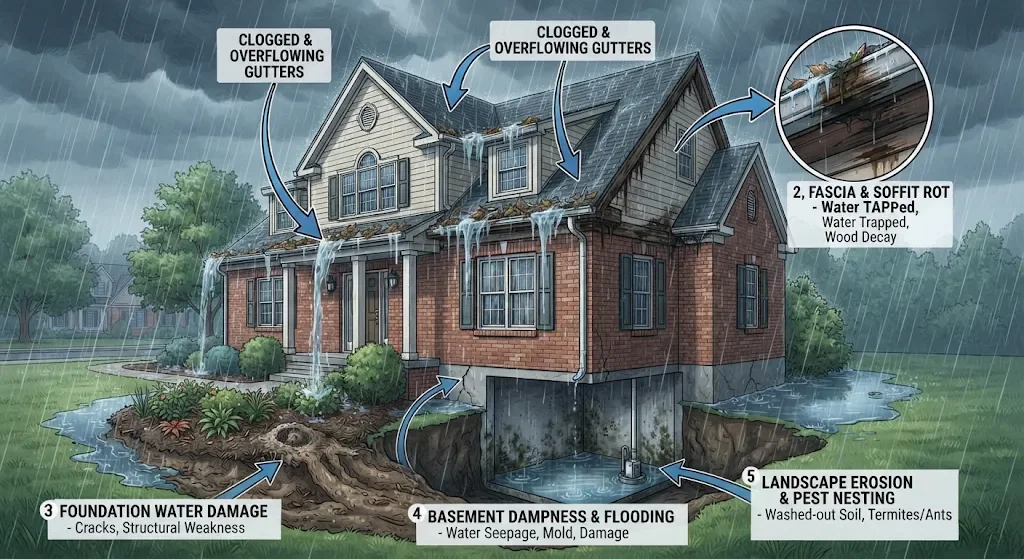
Fascia and Soffit Rot: Standing water and wet leaves sit directly against the wooden fascia boards supporting your gutters. Over time, moisture wicks into the wood, causing rot. Once the fascia softens, heavy wet debris or winter ice can pull the gutter spikes or brackets right out of the wood, causing the entire gutter run to sag or collapse.
Foundation Water Damage: When water spills over the top of clogged gutters, it falls straight down along the perimeter of your house. Over-saturated soil expands and presses against your foundation walls, leading to hydrostatic pressure, concrete cracks, and shifting over repeated freeze-thaw cycles.
Basement Dampness and Flooding: Pooling water around the foundation almost always finds its way inside. Clogged gutters are one of the leading causes of damp basements, musty odors, peeling foundation paint, and ruined flooring in Connecticut homes.
Landscape Erosion and Pest Nesting: Waterfalls pouring off your roofline wash away mulch beds, destroy shrubs, and carve trenches into your yard. Meanwhile, damp, decomposing leaves create an ideal habitat for carpenter ants, mosquitoes, and rodents looking for shelter near your roofline.
Why We Do Not Recommend Doing It Yourself
Climbing up to scoop out a few handfuls of leaves might look like a straightforward Saturday afternoon chore, but DIY gutter cleaning carries real safety and maintenance risks that most homeowners underestimate.
First, there is ladder height and unstable ground. Most Connecticut homes, especially two-story colonials, raised ranches, and split-levels, require working 18 to 25 feet off the ground. In November, the ground around your foundation is often soft from autumn rain or slick with wet leaves and morning frost. Reaching even a foot too far to the side to avoid moving the ladder is the exact cause of most residential ladder falls.
Second, working along the roof edge puts both you and your home at risk. Leaning a standard extension ladder directly against aluminum gutters can dent the metal, bend hangers, or crush drip edges. Walking on a pitched roof in late fall is equally hazardous, as damp leaves and hidden frost on asphalt shingles provide almost zero traction.
Finally, you cannot see what is happening inside the system from the ground. Scooping visible leaves out of the horizontal trough only solves half the problem. Most severe backups happen inside the vertical downspouts or underground drainage elbows. Without flushing the system and checking downspout flow, a hidden blockage just below the roofline can still freeze solid and flood your fascia.
Frequently Asked Questions
What is the best month to clean gutters in Connecticut?
November is the best month for your main annual gutter cleaning in Connecticut. By mid-to-late November, most oak and maple trees have dropped their leaves, allowing you to clear the system right before December freezing temperatures arrive.
How many times a year should I clean my gutters in CT?
Most homeowners in Connecticut should clean their gutters twice a year, once in late spring (late May or June) and once in November. Homes located under heavy tree canopies or dense pine trees often benefit from three cleanings per year.
Can clogged gutters cause ice dams in the winter?
Yes. When gutters are full of wet leaves, trapped water freezes solid during cold nights. That ice block prevents melting roof snow from draining, forcing water to back up under your shingles and form damaging ice dams.
Do I still need gutter cleaning if I have gutter guards?
Yes. Gutter guards block large leaves, but pine needles, shingle grit, seeds, and decomposed organic sludge still collect on top of the mesh or slip inside, requiring periodic inspection and cleaning to maintain proper water flow.
Book Your Gutter Cleaning Before the Freeze
Don't wait until freezing rain or the first winter snowstorm turns trapped leaves into solid ice. Scheduling your November maintenance ensures your gutters and downspouts are completely cleared, flushed, and ready to handle harsh New England winter weather.
If you live in Stamford or surrounding Fairfield County communities, our team at Aladdin Services handles high ladders, thorough debris removal, and full downspout checks safely and efficiently. Visit our gutter cleaning service page to request your estimate or call us directly to lock in your spot before the winter freeze.